
The first time someone told me my W/kg, I nodded like I understood, then quickly pulled out the phone to Google what it all meant.
If you’ve done the same, welcome; you’re in good company.
Watts-per-kilogram, or W/kg, gets thrown around in group chats and HUDs like everyone’s known what it is since birth. Even watch the climbs on this year’s Tour de France to see the internet fawning over Pogi’s bananas 7W/kg as he tore Alpe d’Huez to shreds. We all lost our minds, but why did we do it, what actually is it, and are there benefits to knowing what it’s all about and how it can be used as a metric?
Demystifying w/kg
Power-to-weight ratio, or w/kg, is exactly what it sounds like: how many watts you can produce (your power) divided by your body weight (in kilograms). Push 200W and weigh 70kg and you’re riding at 2.86 W/kg. That’s it, that’s the formula right there.
Why bother dividing it at all?
Well, raw watts don’t tell you much on their own. A 90kg rider, putting out 250W, and a 60kg rider at 200W look different on paper, but on a climb, the lighter rider is moving faster relative to their size. Gravity doesn’t care how many watts you produce; it cares how much mass you’re hauling uphill with you.
When it comes to riding on the flat, aerodynamics and total watts matter plenty, but on a climb, it’s almost entirely about W/kg.
The influence of body mass in endurance bicycling
As a short aside, a now-classic 1994 study by exercise physiologist David Swain, The Influence Of Body Mass In Endurance Cycling, published in Medicine & Science in Sports & Exercise – worth a read by the way, check the link above – modelled exactly this split: on flat ground, air resistance scales with body mass to roughly the power of 0.33, which is a small enough exponent that bigger riders aren’t badly punished, and can even hold an edge because their frontal area doesn’t grow as fast as their engine does.
Uphill, the exponent for the energy cost of climbing is around 0.79, comfortably steeper than the exponent for aerobic capacity (or VO2 max as per the study’s abstract), which is why the smaller riders come out ahead the moment the road points skywards. It’s the maths behind the ‘climbers are skinny, sprinters aren’t’ cliché.
Working through the maths
Let’s say, as a reader, you and your mate John line up for the 4 Passes with the Ox Mountains Cycling Club in Sligo (says he, trying to come up with a decent hilly sportif).
You weigh 65kg (God bless you, I’ll never reach it) and hold 260W on the climb, which is 4.0 W/kg. John weighs 80kg (been there, fleetingly) and holds 300W, which is 3.75 W/kg. Check your own calculations here or use the calculator below.
Watts per Kilogram Calculator
The most argued-about number in cycling. Enter your FTP and weight to see where you sit.
Need both a valid FTP and weight to work this out.
| Category | W/kg (FTP) |
|---|---|
| Untrained | 0.0–1.9 |
| Fair / new to structured training | 2.0–2.9 |
| Moderate (Cat 5 / social racer) | 3.0–3.7 |
| Good (Cat 4) | 3.8–4.4 |
| Very good (Cat 3) | 4.5–5.1 |
| Excellent (Cat 1–2) | 5.2–5.8 |
| Exceptional (domestic pro) | 5.9–6.6 |
| World class (WorldTour) | 6.7+ |
Benchmarks are a rough guide based on commonly-cited amateur/pro FTP power profiles — they skew toward male open-category riders, so treat them as a reference point, not a verdict. Bodyweight, terrain and how you got your FTP number all move where you land.
Chasing a higher number by losing weight has diminishing (and sometimes unhealthy) returns — the honest gains for most of us are in the watts, not the kilos.
John’s producing 40 more watts, but you’re still going to ride away from them on anything steep, because the climb cares about watts-per-kilogram of the whole system (rider plus bike), not just raw output.
On the flat, run both of you into a headwind, and the gap shrinks, sometimes reversing, because aerodynamic drag doesn’t scale with weight the way gravity does. That’s the entire reason W/kg gets quoted for climbs and mountain time trials, while raw FTP or NP (normalised power) gets quoted for flat time trials and sprints.
So, does W/kg matter for training?
In short, yes, in particular if you’re working with a coach, or even if it’s as basic as joining a RoboPacer on Zwift. Some coaches will use W/kg to set training zones because it lets you compare yourself to a defined standard, regardless of your size.
Your FTP (functional threshold power, roughly the power you can hold for an hour) divided by weight gives a benchmark you can track over months. Improve your FTP, drop a few kilos (or both) and the number moves. It’s a genuinely useful way to see progress a raw watts figure can hide.
In my case, I made FTP the big goal in Zwift, constantly looking to boost it, without really paying attention to what I weighed, and wondered why climbs still felt brutal even as my power crept up. Between post-ride toast, the grab bags of Keogh’s after a session (and the rest), I wasn’t doing myself any favours, but I’m working on it for the latter half of this year.
For me right now at 89.2kg and with an FTP as of 1 August of 243W, my power-to-weight ratio is 2.72W/kg. Even if I didn’t change my FTP at all between here and December (someone remind me to come back to this at the end of the year!) but hit my goal weight of 78kg, then my power-to-weight ratio would jump to 3.12W/kg, almost a 14% increase, which should stand to me a bit more performance-wise on the hills around routes near home.
This is also why sports scientists studying professional riders don’t just quote watts either.
A 2006 study tracking pro riders across a six-stage race with SRM power meters, ‘Power output during stage racing in professional road cycling’, found a mean of 3.1W/kg (about 220W) during ordinary mass-start stages, but 5.5W/kg (roughly 392W) during an uphill time trial, where every kilogram is worth noticeably more. Granted, it’s 20 years old and bikes and riders have gotten lighter, but it’s still relevant.
The terrain decides which numbers actually matter, and training plans that only chase watts miss half the picture.
Racing, virtual and otherwise
In real-world racing, W/kg is why pure climbers are whippet-thin, and sprinters carry more muscle. You see it in categorisation too; Zwift racing (and pacing) will use W/kg-based categories because it’s fairer than sorting by raw FTP, which would just group everyone by size.
The RoboPacers in Zwift are a grand low-stakes way to feel the different W/kg levels and test yourself against something that’s not just FTP. If you’ve not encountered them previously, the RoboPacers are AI bits you’ll meet around Watopia, available under 24/7 Group Rides on the home screen too .
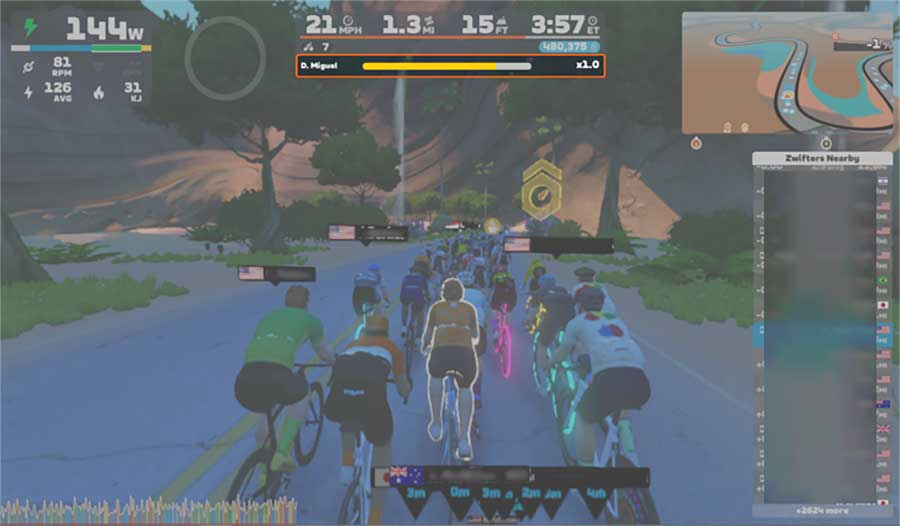
Sofia holds 0.8 w/kg, Bernie sits at 1.5, Miguel at 1.8, up to Constance at 4.2. All ten are set to weigh exactly 75kg. You can learn more about the different RoboPacers here.
So why W/kg then and not just ride at 25km/h? Because speed depends entirely on gradient, which punishes weight disproportionately. A pacer holding a steady speed would need wildly different power on the flat versus a 10% climb. One holding steady W/kg behaves naturally. The RoboPacers increase their power up to 10% on climbs and ease off up to 20% on the descent to mimic how a real rider shifts effort with the terrain.
Speed then becomes the output, as opposed to the input, which is why a RoboPacer group feels like riding with humans instead of robots on rails.
Want to test yourself? Pick a RoboPacer slightly above your normal W/kg and try hang on for a lap. It’s one of the more honest fitness tests going or a great way to blow it out at the end of a day. You versus the robots, how bad.
There’s a nice real-world validation of this virtual training loop too for us mere amateur mortals, found in a 2025 peer-reviewed case study on a Zwift Academy winner’s transition into the pro peloton, which found their sustained W/kg numbers, not just their absolute power, tracked closely with the physiological demands of actual road racing.
Should amateurs actually care?
Yes, I’m told, we should care, but with a caveat.
If you’re new to structured training, like everything else, don’t let W/kg become the only number you look at. It’s like trying to improve your diet and focusing solely on what the bathroom scale shows between your feet. W/kg is genuinely useful for tracking climbing performance and setting category benchmarks to aid training, but, like FTP, it’s not the whole picture.
Bike handling (on the road), pacing, aerodynamics and just plain old experience all matter, especially in real-world racing where positioning can outweigh a 0.1W/kg gap.
Is lighter just better, then?
Not quite and not always, in my limited experience. Sure, it can be great to be lighter on the bike, but it’s not always better and this is where people get themselves into trouble, or potentially into trouble in particular around nutrition.
Chasing a higher W/kg ratio purely by losing weight is a trap. Any coach or podcast these days will advise you of the same. Drop weight carelessly, and you often lose muscle, and with it goes the very watts you were trying to leverage. I’ve seen (and briefly been) the cyclist who under-fuels for a season (largely on the bike, again, a story for another post), hits a nice number on the scale, and can’t produce a meaningful sprint any more. The number goes up, but the riding doesn’t go with it.
W/kg is a ratio, and you can improve on either side of it. Building power through structured training – my intention for the coming months, August in particular – is usually the more sustainable route, especially for anyone already at a reasonable, healthy weight.
Losing weight helps too, but only down to a point, and only if it doesn’t cost you on the power side of the equation. Like most things in cycling, it’s a trade-off and not a cheat code.
I’m not throwing out armchair (or office chair) caution either. A 2024 study tracking BMI among the top five finishers at Grand Tours and Monuments from the 1990s until 2023 found a clear downward trend over the decades, with researchers flagging it as a genuine health and governance concern for the sport, not just a performance story.
“These declining trajectories suggest a need for enhanced awareness in the cycling community and possible regulatory measures and educational programmes to promote the sustainable wellbeing of riders. This may be particularly pertinent given the wider evidence of unhealthy weight-related attitudes and behaviours throughout the sport”, according to the study.
If pro cycling’s own stakeholders are worried the chase for lower race weight has gone too far, there’s a decent signal for the rest of us to not treat ‘lighter’ as an unqualified goal.
Ken
Extra reading
I’ve included some of the studies I’ve found in links above, but if you’ve missed them, here’s the list in full.
Swain, D.P. (1994). “The influence of body mass in endurance bicycling.” Medicine & Science in Sports & Exercise, 26(1), 58–63. The foundational paper on why weight hurts you uphill but barely touches you on the flat.
Nevill, A.M., Jobson, S.A., Davison, R.C.R., & Jeukendrup, A.E. (2006). “Optimal power-to-mass ratios when predicting flat and hill-climbing time-trial cycling.” European Journal of Applied Physiology. A more refined model of how power-to-mass should be weighted differently for flat versus hilly time trials.
Vogt, S., Heinrich, L., Schumacher, Y.O., et al. (2006). “Power output during stage racing in professional road cycling.” Medicine & Science in Sports & Exercise, 38(1), 147–151. Real SRM-measured w/kg data from a professional multi-stage race.
Vogt, S., et al. (2007). “Cycling power output produced during flat and mountain stages in the Giro d’Italia: A case study.” Journal of Sports Sciences, 25(12). Concrete flat-versus-mountain w/kg figures from a Grand Tour.
Smith, A., Wyler, H., van Wijnkoop, M., Colangelo, J., Liebrenz, M., & Buadze, A. (2024). “Body Mass Index Trends for the Top Five Finishers in Men’s Grand Tour and Monument Cycling Events from 1994–2023.” Sports, 12(7), 178. The decades-long trend toward lighter GC contenders, and why it’s a stakeholder concern, not just a stat.
“From Amateur to Professional Cycling: A Case Study on the Training Characteristics of a Zwift Academy Winner.” A rare peer-reviewed look at how virtual training numbers held up against real-world professional demands.
Zwift Insider, “Rider Categorization Based on FTP: How Do I Rank?” Not academic, but the most practical, up-to-date w/kg benchmark table for amateur riders you’ll find anywhere.